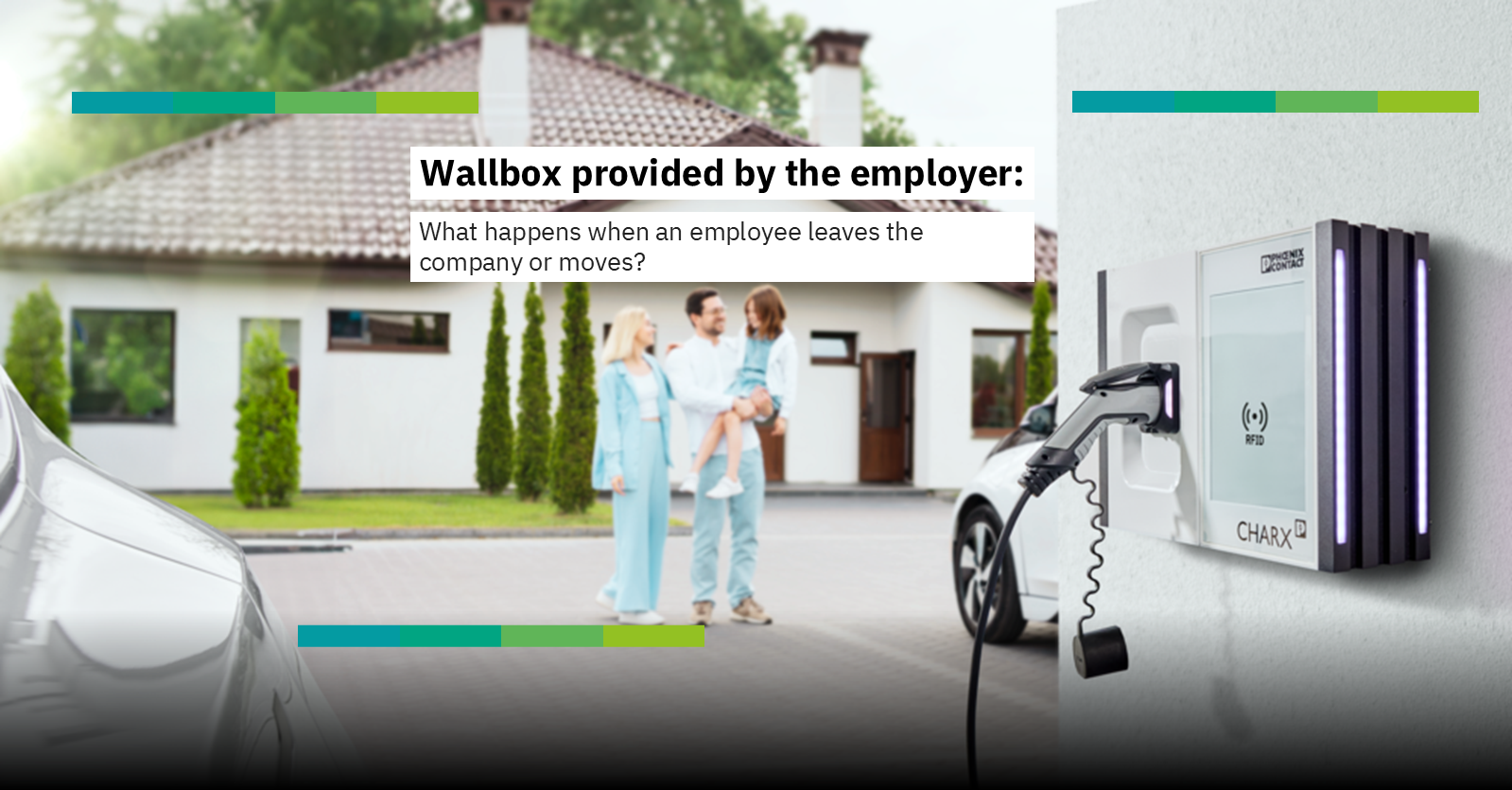
Employees who charge an electric company car at home need suitable charging infrastructure. Companies support their employees in different ways: They provide a wallbox, subsidize the purchase or leave the organization entirely to the company car drivers.
But what happens to the wallbox provided by the employer when an employee leaves the company or moves to a new home? Who owns the wallbox? Does it have to be removed? And what are the potential tax implications if the employee takes ownership of it?
Companies should not wait until an employee leaves to address these questions. Clearly defining ownership, costs and responsibilities from the outset can help avoid additional expenses and administrative effort later on.
Who owns the wallbox for the company car?
Whether the wallbox belongs to the company or the employee depends on the model chosen when it was purchased. There are three main options.
1. The wallbox belongs to the company
If the company purchases the wallbox and provides it to an employee for charging a company car at home, the company can remain the owner of the charging equipment.
The temporary free or discounted provision of company-owned charging equipment may be tax-free under Section 3 No. 46 of the German Income Tax Act (EStG) , provided that the statutory requirements are met. The current guidance from the German Federal Ministry of Finance explicitly distinguishes between the temporary provision of charging equipment and the permanent transfer of ownership.
However, this model also raises organizational questions. Companies should define in advance what happens to the wallbox if the company car is returned, the employee moves or leaves the company.
The operator role should also be taken into account. Learn more about operator responsibility for wallboxes in companies in our detailed blog article.
2. The wallbox belongs to the employee
If the employee purchases the wallbox, it remains their property. This means that the charging infrastructure is not directly tied to their employment relationship.
When changing employers, the wallbox generally does not have to be returned to the previous company. At the same time, responsibilities for maintenance, repairs and any future removal generally lie with the owner or need to be defined accordingly.
For companies, this model can reduce administrative effort.
3. The company subsidizes the wallbox
Another option is for the employer to subsidize a privately purchased wallbox. In this case, the charging equipment generally belongs to the employee.
Tax regulations also apply to this model. Employer subsidies for expenses related to the purchase and use of charging equipment may, subject to the statutory requirements, be taxed at a flat rate in accordance with Section 40 (2), sentence 1, no. 6 EStG .
Companies should nevertheless clearly define which costs are covered and whether specific conditions apply to the subsidy.
We explain the financing and subsidy options available to companies in detail in our article “Employer-Funded Home Charger: Added Value or Added Effort? ”
What happens to the wallbox when an employee leaves the company?
The question of ownership becomes particularly important when an employee leaves the company.
If the wallbox already belongs to the employee, the situation is relatively straightforward. The wallbox can remain at their home and continue to be used independently of their previous employment relationship.
The situation is different if the wallbox belongs to the company. In this case, there are several possible solutions.
Removal and return
The company can request the return of the wallbox or other components it owns. As work on the electrical installation may be necessary, removal may need to be carried out by a qualified electrician.
Before doing so, companies should assess whether removing the equipment makes economic sense. In addition to the removal itself, further costs may arise for transportation, inspection, storage and subsequent installation at another location.
Transfer of the wallbox to the employee
Instead of removing the wallbox, transferring ownership to the employee can be a practical solution. This may be particularly useful if the cost of removal would be disproportionately high.
However, if ownership is transferred free of charge or at a reduced price, the tax implications need to be considered. Under certain conditions, German tax law allows the employer to apply a flat-rate wage tax of 25 percent to the transfer of charging equipment in accordance with Section 40 (2), sentence 1, no. 6 EStG.
It is important to note that the employee leaving the company does not automatically trigger taxation of the wallbox’s residual value. Among other factors, the tax treatment depends on whether ownership of the wallbox is transferred to the employee and under what conditions.
Sale at residual value
Alternatively, the company can sell the wallbox to the departing employee. The value used for the sale should be determined transparently and documented accordingly.
Factors such as the original purchase price, age, condition and technical status of the wallbox may be relevant when determining its value. Companies should consult their tax advisor to determine how the value should be assessed for tax purposes in each specific case.
Download our charge@home Guide now!
Our guide highlights the requirements for a home charging solution and explains what is needed to use it for legally compliant billing of company cars. Learn more about the installation of wallboxes, legal frameworks, and efficient billing solutions for home charging.
REQUEST GUIDE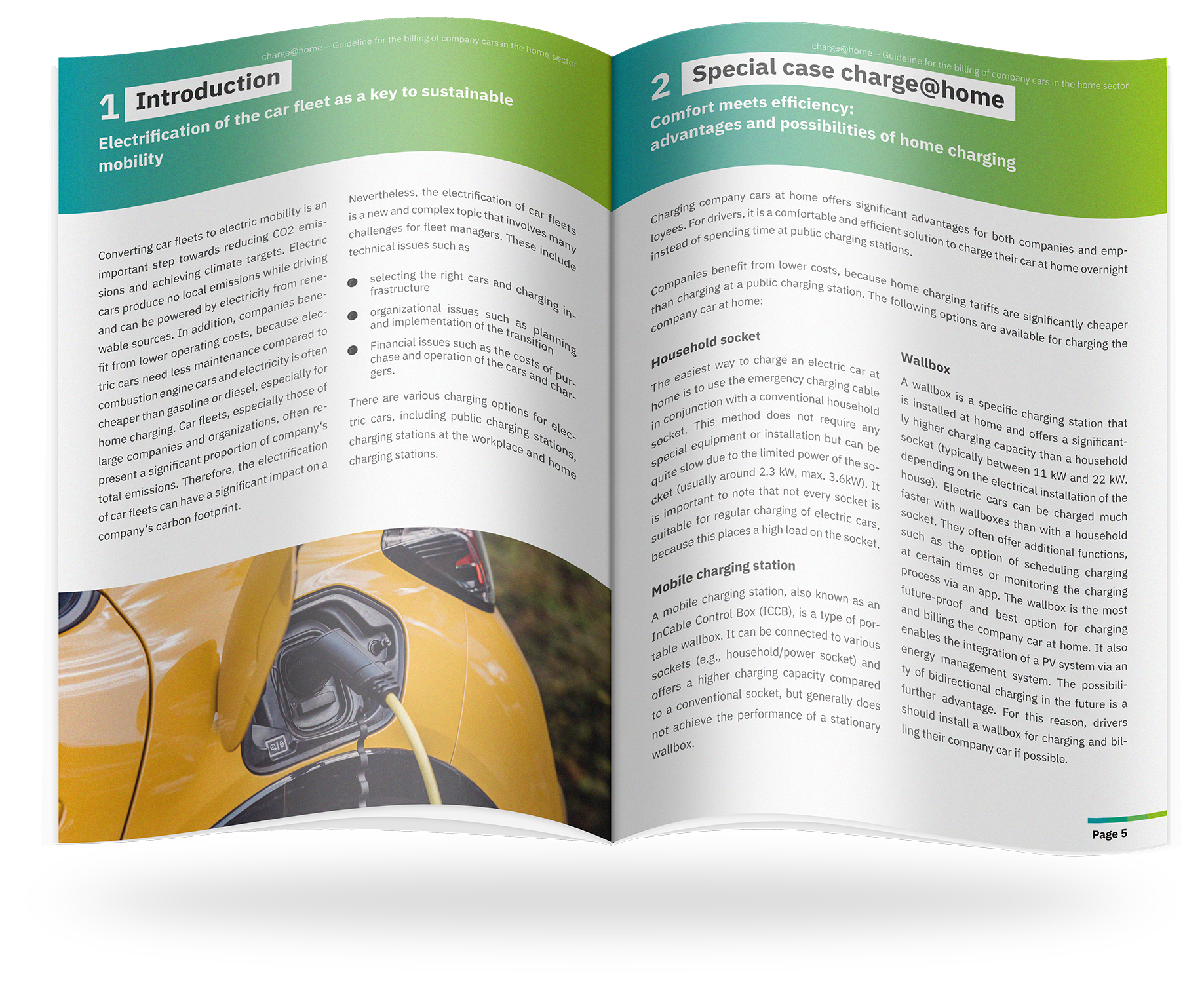
What happens to the wallbox when an employee moves?
Moving to a new home can also create additional challenges, particularly if the wallbox belongs to the company.
The first question is whether the existing wallbox should remain at the current residence or be removed. If it is to be used at the employee’s new home, the technical requirements at the new location must first be checked.
Depending on the situation, additional costs may arise for:
Removing the existing charging equipment
Hiring a qualified electrician and covering travel costs
Adapting the electrical installation
Work on the meter cabinet
Reinstalling the wallbox at the new residence
Testing and commissioning the wallbox
For companies, a move can therefore become considerably more complex if they own the entire charging infrastructure.
If the wallbox belongs to the employee, on the other hand, ownership and responsibilities are more clearly separated.
What companies should define before installing a wallbox
To prevent an employee’s departure or move from becoming a source of uncertainty, companies should establish clear rules when introducing a charge-at-home solution.
A company car policy or supplementary agreement should define, among other things:
Who owns the wallbox?
Who pays for the purchase and installation?
Who is responsible for maintenance and repairs?
What happens if the employee moves?
Who pays for any necessary removal?
What happens when the employment relationship ends?
Can the employee take ownership of the wallbox?
How is the value of the wallbox determined if necessary?
What happens to additional metering and communication hardware?
How is the reimbursement of electricity used to charge the company car at home terminated?
The more clearly these questions are addressed, the easier it is to manage changes later on.
Keeping the wallbox and company car reimbursement flexible
One way to reduce administrative effort is to avoid linking the choice of wallbox too closely to the reimbursement of electricity used for charging a company car.
This is where the Charge Repay Service comes in. Employees can choose a new wallbox or continue using an existing system. This means that an existing charging solution does not necessarily have to be replaced with a specific wallbox model. The Charge Repay Service enables the automated recording and reimbursement of the electricity used to charge a company car at home.
We explain the available reimbursement methods in more detail in our article “Charging Company Cars at Home: Flat Rate or Precise Billing?” .
This flexibility can be particularly useful when there are changes within the company fleet. If a company car driver leaves the company, the assigned license can be reassigned to another employee in line with the existing application concept. Individual hardware components can also be reused.
For companies, this means that reimbursement is less dependent on a specific wallbox model. At the same time, employees have greater flexibility to adapt their home charging infrastructure to their individual requirements. Learn more about how to separate private and business charging sessions at a wallbox .
Conclusion: Plan for future changes from the outset
Charging a company car at home is not only about choosing the right wallbox and reimbursing electricity costs. Companies should also consider what happens to the charging infrastructure when an employee’s circumstances change.
In particular, ownership, removal, cost responsibilities and the handling of the wallbox when an employee leaves the company or moves should be defined in writing.
Greater flexibility can be achieved when private charging infrastructure is not unnecessarily tied to one employer or a specific reimbursement system. A wallbox-independent solution such as the Charge Repay Service can help separate the reimbursement of electricity used for company car charging from the wallbox itself.
Note: The tax treatment depends on the contractual arrangement and the individual circumstances. This article does not constitute tax or legal advice.