Using an electric company car not only offers environmental benefits, but can also provide significant tax advantages. In this article, you will learn how the 0.25% rule works, which requirements apply to electric and hybrid vehicles, and how companies can reimburse electricity costs for charging a company car at home tax-free.
Many of the rules from the previous year will continue to apply in 2027. However, there is one important change to the flat electricity rate: In 2027, the rate decreases from €0.34 to €0.32 per kilowatt-hour. Alternatively, companies can continue to reimburse the actual electricity costs. Both methods require the amount of electricity used to charge the company car at home to be documented.
All tax benefits mentioned in this article apply specifically to German tax regulations.
Overview of Tax Benefits for Electric and Hybrid Vehicles
The following table provides an overview of the most important tax rules for electric and hybrid vehicles in 2027. More detailed information on each topic can be found later in this article.
| Description | Regulation | Vehicle type | Amount or benefit |
|---|---|---|---|
| Temporary provision of a home charging station | Section 3 No. 46 EStG | Electric and hybrid vehicles | Tax-free if statutory requirements are met |
| Transfer of ownership of a home charging station or subsidy | Section 40 (2) Sentence 1 No. 6 EStG | Electric and hybrid vehicles | Flat-rate wage tax of 25% may apply |
| Charging at the company premises | Section 3 No. 46 EStG | Electric and hybrid vehicles | Tax-free if statutory requirements are met |
| Reimbursement using the flat electricity rate in 2027 | Tax-free reimbursement of expenses | Electric and hybrid company cars | €0.32/kWh |
| Reimbursement of actual charging costs | Tax-free reimbursement of expenses | Electric and hybrid company cars | Based on the individual electricity price |
| Taxable benefit for fully electric company cars with a gross list price of up to €100,000 | 0.25% rule | Electric vehicles acquired from July 1, 2025 | 0.25% of the gross list price per month |
| Taxable benefit for fully electric company cars with a gross list price above €100,000 | 0.5% rule | Electric vehicles | 0.5% of the gross list price per month |
| Taxable benefit for qualifying plug-in hybrids | 0.5% rule | Plug-in hybrid vehicles | 0.5% of the gross list price per month |
| Declining-balance depreciation for company electric vehicles | Investment incentive | Fully electric company vehicles | 75% in the year of acquisition |
Tax-Free Provision of Home Charging Stations
Companies can provide employees with a company-owned home charging station for temporary private use in addition to their regular salary. The resulting benefit can be tax-free under Section 3 No. 46 of the German Income Tax Act (EStG) , provided the statutory requirements are met.
A distinction must be made between the temporary provision of a home charging station and the permanent transfer of ownership. If ownership of the home charging station is transferred to the employee, this no longer constitutes a tax-free temporary provision. Under certain conditions, the employer can apply a flat wage tax rate of 25%.
A subsidy granted in addition to the regular salary for a privately owned home charging station can also be subject to a flat wage tax rate of 25% under Section 40 (2) Sentence 1 No. 6 EStG .
Guide to choosing a Wallbox: Your comprehensive Guide!
Our guide provides you with important insights into the details you should consider before purchasing a wallbox. Learn about the key criteria to make the right choice for your home and company car.
REQUEST GUIDE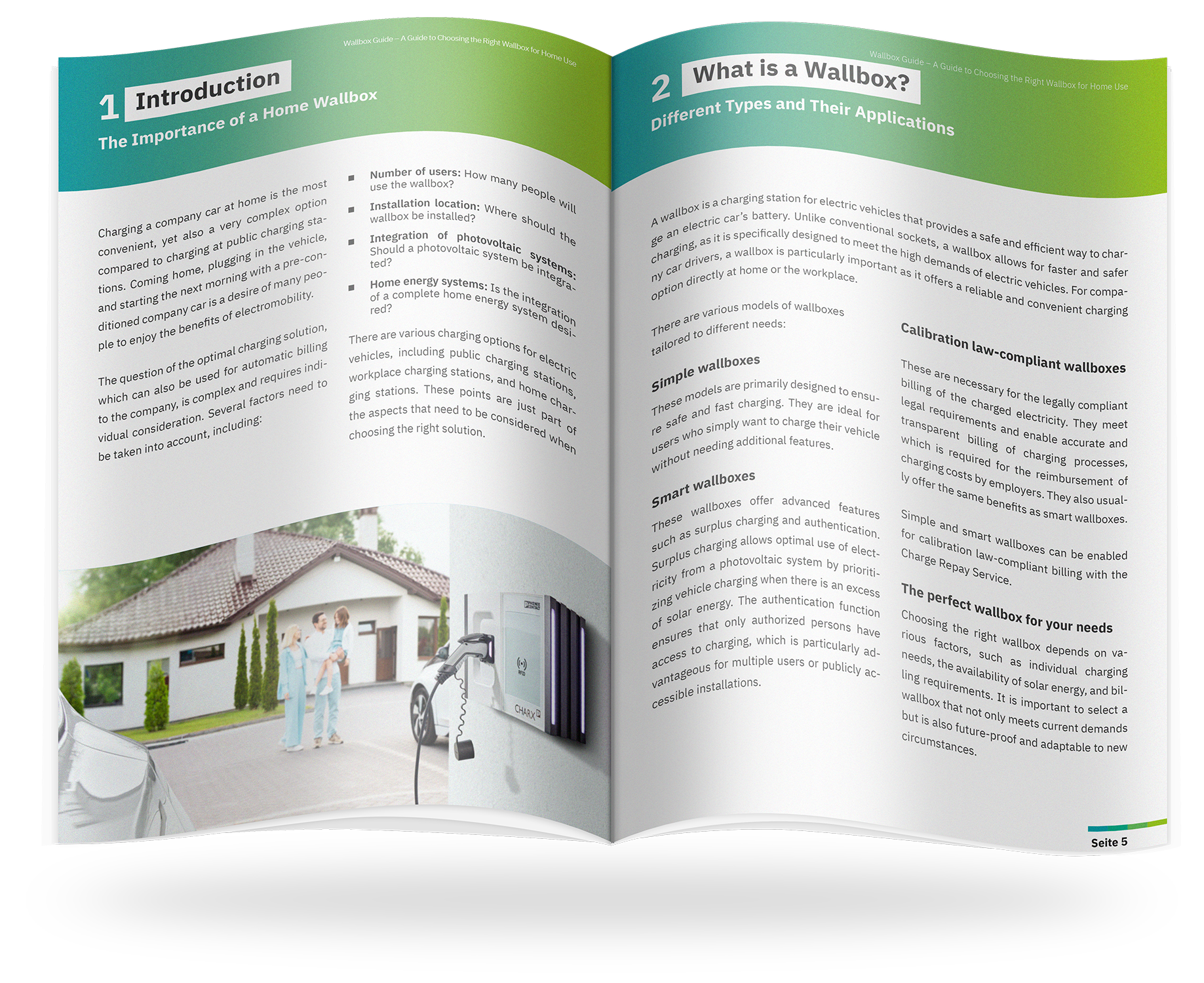
Tax-Free Charging at the Company Premises
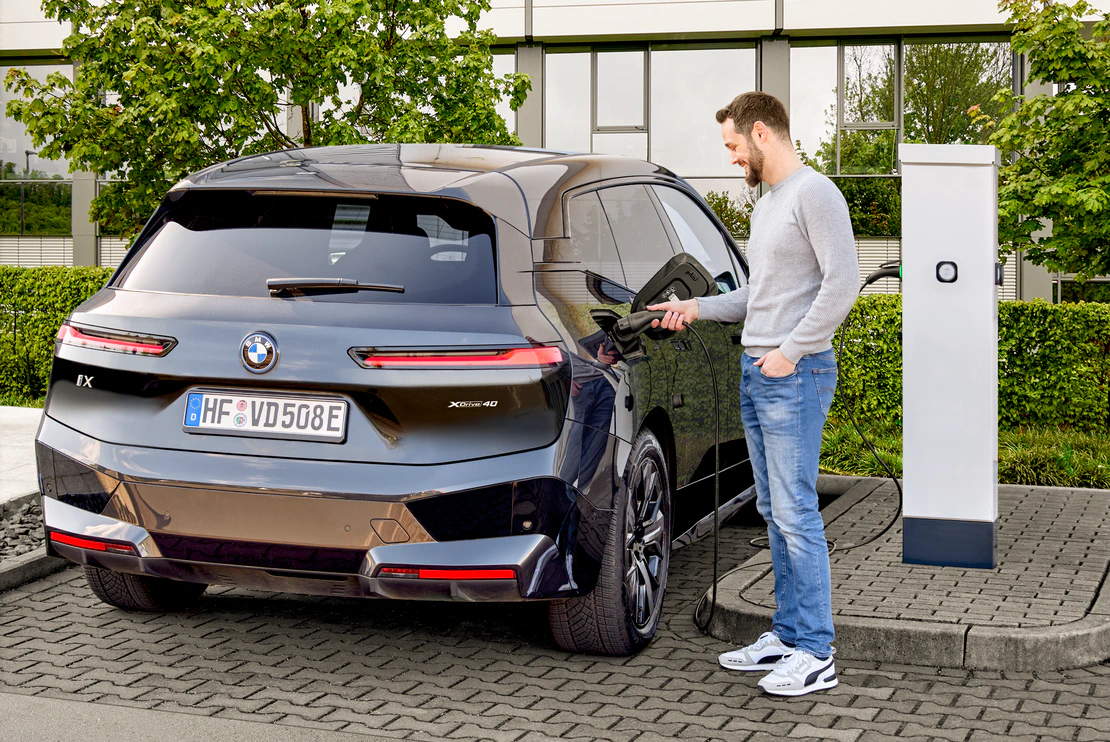
Free or discounted charging of electric and hybrid vehicles at the employer’s premises is tax-free under Section 3 No. 46 EStG if the benefit is provided in addition to the employee’s regular salary. This applies to both privately owned vehicles and company cars.
The tax exemption is not limited to a specific maximum amount or number of eligible vehicles. Under current legislation, it applies until the end of 2030.
Companies are not required to provide employees with charging facilities. However, if they choose to do so, charging at the workplace can provide an attractive tax-free benefit.
Reimbursement of Expenses for Company Cars
The tax exemption under Section 3 No. 46 EStG does not directly apply to electricity purchased by employees at home or from a third party to charge a company car.
However, employees can still be reimbursed for privately paid electricity costs free of tax. In the case of a company car, the reimbursement can qualify as tax-free reimbursement of expenses if the relevant requirements and documentation obligations are met.
In 2027, companies can generally calculate home charging costs in two ways:
using the flat electricity rate of €0.32 per documented kilowatt-hour, or
based on the actual electricity costs.
Both methods require the amount of electricity used to charge the company car to be documented.
Flat Electricity Rate in 2027: €0.32 per Kilowatt-Hour
Since January 1, 2026, the previous monthly allowances of €15, €30, €35, or €70 can no longer be used. Instead, companies can use the flat electricity rate when reimbursing employees for charging a company car at home.
The rate is based on the average household electricity price for the first half of the previous year, published by the German Federal Statistical Office.
For 2027, the flat electricity rate is €0.32 per kilowatt-hour. In 2026, it was €0.34 per kilowatt-hour.
The calculation is straightforward:
Documented charging volume × €0.32 = tax-free reimbursement
For example, if an employee documents 3,000 kilowatt-hours of electricity used to charge a company car at home in 2027:
3,000 kWh × €0.32 = €960
In this example, the company can reimburse €960 as tax-free expenses.
The flat electricity rate eliminates the need to document the employee’s individual electricity price. However, it does not eliminate the requirement to document the amount of electricity used to charge the company car.
Companies and employees must therefore continue to record how many kilowatt-hours are used at home for the company car.
The calculation method chosen for a calendar year should generally be applied consistently throughout that calendar year.
Guidance from German Verification Authorities on Home Charging
At the beginning of 2026, German verification authorities published additional guidance on billing electricity used to charge company cars at home.
In clearly defined one-to-one scenarios, a MID meter may be sufficient for billing under certain conditions. However, measuring devices that are simply integrated into a charging cable do not automatically meet the requirements for legally compliant billing.
The measurement technology required depends on the individual billing scenario. More information can be found in our article Home Charging for Electric Company Cars: German Verification Authorities Clarify Legally Compliant Billing .
Reimbursement of Actual Charging Costs Based on Exact kWh Consumption
As an alternative to the flat electricity rate, companies can reimburse the actual electricity costs. To do so, both the amount of electricity charged and the employee’s individual electricity price must be documented.
Electricity consumption can be recorded using a separate electricity meter or a suitably equipped home charging station, for example.
Manual kWh-based reimbursement:
The employee regularly reads the amount of electricity used from a suitable meter or home charging station and submits the data to the company for reimbursement. The applicable electricity price must also be documented. This method reflects actual costs but requires continuous documentation and may require additional technical equipment .
Automatic kWh-based reimbursement:
With automatic data collection, the relevant charging sessions are recorded automatically and transferred to a billing backend. Charging sessions can be assigned to the company car using RFID, for example. Automatic transmission reduces manual effort and supports transparent reimbursement.More information can be found in our article Charging and Reimbursing a Company Car at Home .
The Charge Repay Service from Phoenix Contact enables automatic, accurate, and efficient reimbursement of the kilowatt-hours used to charge company cars. The service records the relevant charging sessions and simplifies the reimbursement process for companies and employees.
Download our charge@home Guide now!
Our guide highlights the requirements for a home charging solution and explains what is needed to use it for legally compliant billing of company cars. Learn more about the installation of wallboxes, legal frameworks, and efficient billing solutions for home charging.
REQUEST GUIDE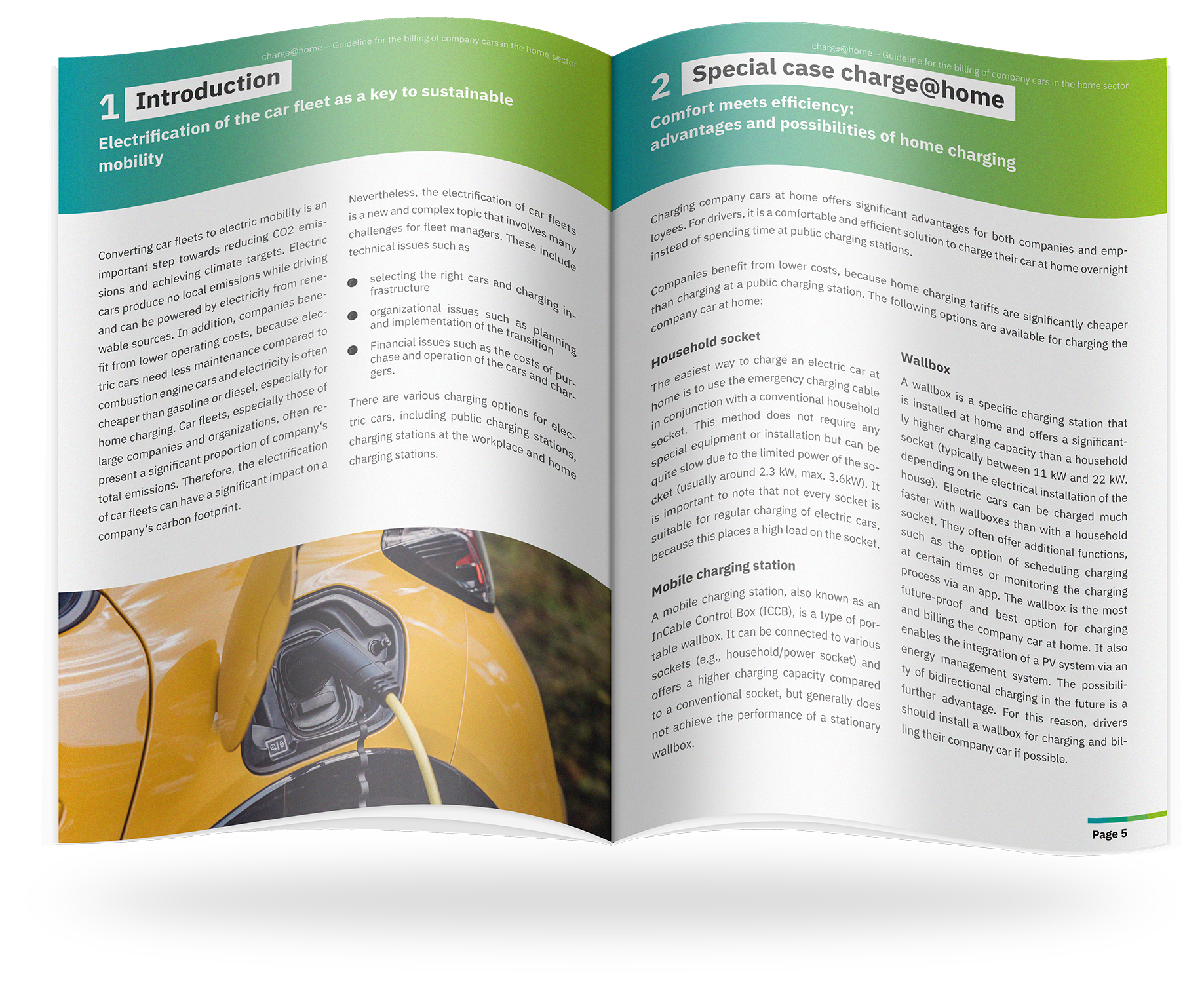
Further Information on Taxes and Electric Company Cars
The 0.25% Rule for Fully Electric Company Cars
When a company car is also used privately, this private use creates a taxable benefit. The benefit can generally be calculated either using a flat-rate method or based on a compliant driver’s logbook.
For fully electric company cars, the 0.25% rule can be applied under certain statutory conditions. For vehicles acquired on or after July 1, 2025, a gross list price threshold of €100,000 applies.
If the gross list price does not exceed this threshold, 0.25% of the gross list price is treated as a taxable benefit each month.
For example, for a vehicle with a gross list price of €60,000:
€60,000 × 0.25% = €150 taxable benefit per month
If the gross list price exceeds €100,000, the assessment basis is generally reduced by half. For the flat-rate calculation, this effectively results in the 0.5% rule.
The €100,000 threshold does not apply retroactively to every electric company car. The applicable threshold depends, among other things, on when the vehicle was acquired:
| Acquisition period | Applicable gross list price threshold |
|---|---|
| Until December 31, 2023 | €60,000 |
| January 1, 2024 to June 30, 2025 | €70,000 |
| From July 1, 2025 | €100,000 |
The increase of the threshold to €100,000 is part of Germany’s tax incentives for electric mobility.
Driver’s Logbook as an Alternative to the 0.25% Rule
Instead of using the flat-rate method, employees can use a compliant driver’s logbook. Business and private journeys must be documented completely. The private share is then calculated based on the vehicle’s actual costs.
The driver’s logbook method can be particularly beneficial if the company car is only used privately to a limited extent. However, it requires considerably more documentation.
The selected method of calculating the taxable benefit generally has to be applied consistently for the relevant calendar year.
Declining-Balance Depreciation for Company Electric Vehicles
A special declining-balance depreciation method is available for fully electric company vehicles. To qualify, the vehicle must be acquired after June 30, 2025 and before January 1, 2028.
Companies can deduct 75% of the acquisition costs for tax purposes in the year of acquisition. The remaining acquisition costs are depreciated over the following five years.
This means that 2027 is the final full acquisition year in which companies can benefit from this regulation.
Plug-in hybrid vehicles are not eligible for this particular depreciation method.
Taxation of Hybrid Company Cars
Plug-in hybrids can also benefit from preferential tax treatment. Qualifying hybrid company cars can generally use the 0.5% rule when applying the flat-rate method.
The vehicle must meet at least one of the following requirements:
CO₂ emissions must not exceed 50 grams per kilometer.
The purely electric range must be at least 80 kilometers.
These are alternative requirements. A plug-in hybrid therefore does not need to meet both criteria at the same time.
If the vehicle does not meet either condition, the taxable benefit cannot be calculated using the preferential 0.5% rule. In this case, the standard 1% rule generally applies when using the flat-rate method.
Alternatively, a compliant driver’s logbook can also be used for a plug-in hybrid.
The recording of charging electricity and the taxation of private vehicle use must be considered separately. Recording the kilowatt-hours used for charging determines the electricity costs to be reimbursed. It does not determine the taxable benefit resulting from private use of the company car.

Vehicle Tax Exemption for Fully Electric Vehicles
Fully electric vehicles may continue to qualify for an exemption from German vehicle tax.
For vehicles that are first registered by December 31, 2030, the exemption can generally apply for up to ten years. It ends no later than December 31, 2035.
If ownership of the vehicle changes, the exemption can continue for the remaining eligible period. The specific requirements are set out in Section 3d of the German Motor Vehicle Tax Act (KraftStG) .
Charging a Private Electric Car at the Company Premises
Companies can allow employees to charge privately owned electric or hybrid vehicles at the workplace. The resulting benefit can be tax-free under Section 3 No. 46 EStG if the charging is provided in addition to the employee’s regular salary.
Companies are not required by law to offer charging facilities. However, providing workplace charging gives employees access to a convenient charging solution and can support a company’s overall electric mobility strategy.
Conclusion: Tax Benefits for Electric Company Cars in 2027
Electric company cars continue to offer significant tax benefits in 2027. The 0.25% rule can substantially reduce the tax burden associated with the private use of a fully electric company car. Companies can also offer tax-free charging at the workplace and provide company-owned home charging stations under preferential tax conditions.
For charging a company car at home, a flat electricity rate of €0.32 per documented kilowatt-hour applies in 2027. Alternatively, companies can reimburse the actual electricity costs. In both cases, the amount of electricity used to charge the company car must be documented.
2027 is also an important year for companies planning to invest in electric fleets. It is the final full acquisition year for the special declining-balance depreciation for fully electric company vehicles, which allows 75% of the acquisition costs to be depreciated in the year of acquisition.
Automatic and transparent recording of charging sessions can help companies reduce administrative workload and implement an efficient home charging reimbursement process.