Which is cheaper for a company: an electric company car or a combustion-engine car? The deciding factor is the total cost over the period of use, known as TCO (Total Cost of Ownership). This includes vehicle costs, energy, running costs, charging infrastructure and billing.
We compare two company cars: the VW ID.7 Tourer Pro and the VW Passat Variant 2.0 TDI Business DSG. The calculation covers depreciation, the cost of tied-up capital, energy, operation, charging infrastructure and administration. List prices and key technical specifications are supported by sources. Future resale values and costs not supported by specific quotations are explicitly treated as model assumptions.
Company-car TCO: Which costs should be included?
TCO brings together the costs attributable to the vehicle from the company’s perspective. Both vehicles are compared over the same period and mileage. Four cost categories apply to both powertrain types:
Vehicle costs: When buying, use the purchase price minus the expected resale proceeds. Add delivery, registration and the cost of tied-up capital. For leasing, use lease payments and contractual additional charges instead. Do not add depreciation on top of lease payments or count both actual financing interest and imputed capital costs.
Energy and running costs: Compare the energy costs of both vehicles: electricity for the EV and fuel for the combustion-engine car. Also include maintenance, repairs, wear and tear, insurance and vehicle tax.
Charging infrastructure: Allocate the company-funded costs of the wallbox, installation, metering and operation to the vehicle being assessed. Take its share of use into account.
Billing and administration: Include service fees and internal working time for recording, checking and reimbursement. Do not count costs already included in other items again.
TCO = vehicle costs + energy and running costs + allocated infrastructure costs + billing and administration costs. Divide by the months of use to obtain average monthly costs, or by total mileage to obtain the cost per kilometre. What matters is the total, not the advantage in a single item.
The baseline: 100,000 kilometres over four years
Our electric company car is the VW ID.7 Tourer Pro with 210 kW (286 PS) and a usable battery capacity of 77 kWh. We compare it with the VW Passat Variant 2.0 TDI Business DSG with 110 kW (150 PS). The Passat is deliberately a diesel, not a petrol model or plug-in hybrid. Both are large estate cars without manual gear changes. The comparison concerns a similar business use case, not identical power output.
Price reference date and period:
We use German list-price information researched on 18 November 2026. The calculation assumes the purchase of a new vehicle at the end of 2026. The four-year period of use therefore ends at the end of 2030. Resale proceeds after four years are future assumptions, not observed four-year values: ADAC has listed the ID.7 Tourer only since June 2024 and the Passat B9 since 2024. Current used-car listings therefore provide market context only, not evidence of future proceeds.
According to the ADAC model page for the ID.7 Tourer Pro , its base list price is €55,305. ADAC quotes €52,600 for the Passat Variant 2.0 TDI Business DSG, model specification from June 2025 . Both amounts include VAT and exclude additional optional equipment. Sources accessed: 18 November 2026. Advertised discounted entry prices are not used as list prices.
Calculation framework:
We assume purchase at the stated list price and use over four years, or 48 months. Annual mileage is 25,000 km. This remains a gross-cost model for a company not entitled to deduct input VAT. Expenses subject to VAT and resale proceeds are included gross; insurance and vehicle tax are included at the amounts payable. Companies entitled to deduct input VAT need a separate net-cost calculation. Discounts, purchase grants and German greenhouse-gas quota revenues (THG revenues) are each assumed to be zero in the baseline scenario.
Download our charge@home Guide now!
Our guide highlights the requirements for a home charging solution and explains what is needed to use it for legally compliant billing of company cars. Learn more about the installation of wallboxes, legal frameworks, and efficient billing solutions for home charging.
REQUEST GUIDE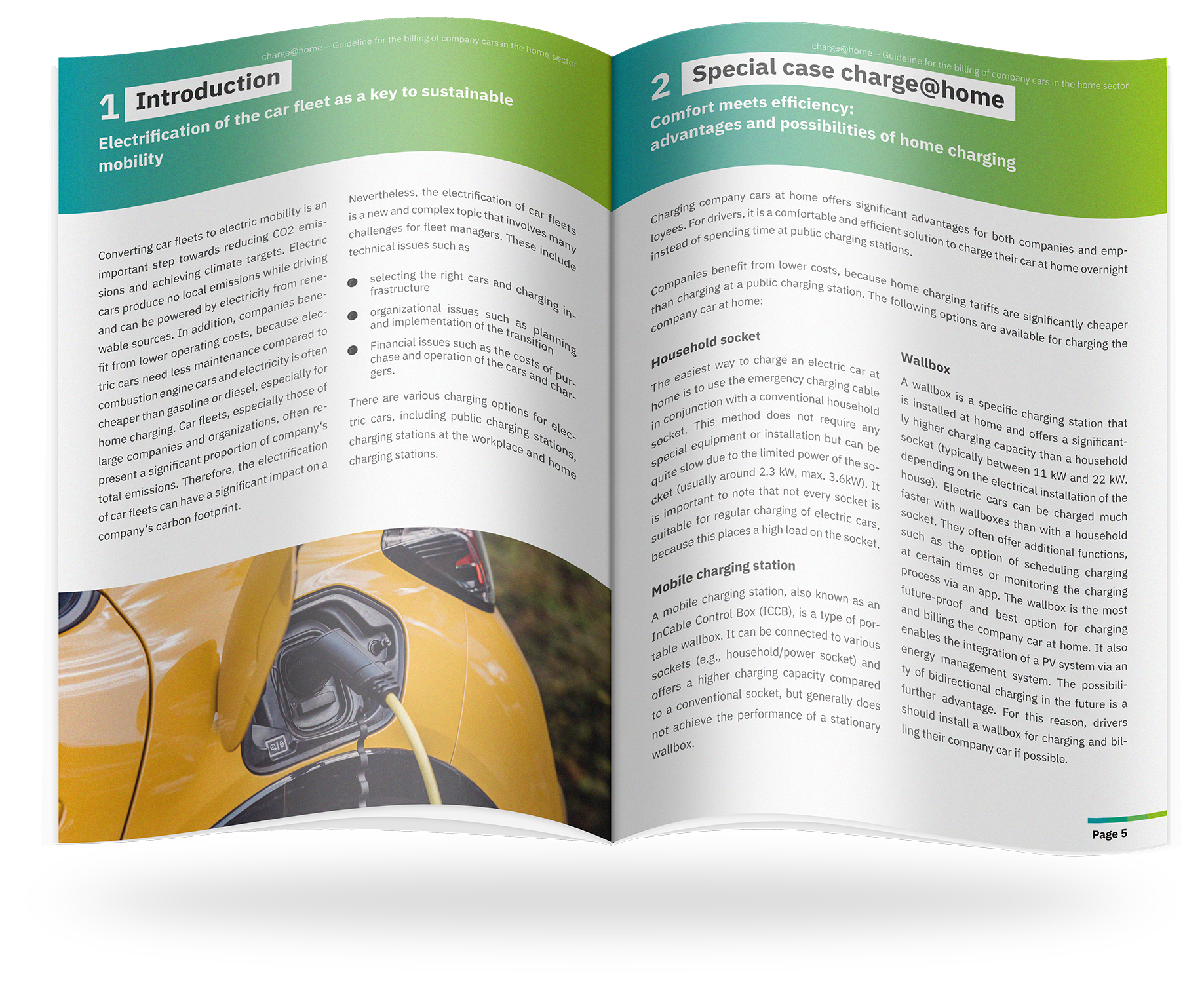
Why these two vehicles?
The Pro and Business versions offer a comparable basic specification for company-car use, but their equipment is not identical. The following features and differences come from the German equipment summaries for the ID.7 Tourer Pro and Passat Business (accessed: 18 November 2026). Check the scope of functions and activations in the specific quotation. Preparation for a function does not mean that the function is already included.
| Equipment comparison | ID.7 Tourer Pro | Passat Variant Business |
|---|---|---|
| Body style and controls | Estate car with electric drive selector | Estate car with 7-speed DSG |
| Shared basic comfort features | Automatic climate control, heated front seats | Automatic climate control, heated front seats |
| Shared basic driver-assistance features | Adaptive cruise control, lane-keeping assist, reversing camera | Adaptive cruise control, lane-keeping assist, reversing camera |
| Cockpit and climate control | 15-inch display, head-up display; 2-zone climate control with activation option | 12.9-inch display, digital instrument cluster; 3-zone climate control |
| Remaining differences | Significantly higher power output; equipment summary lists navigation as prepared for activation | Navigation system and ergoActive seats according to the Business equipment summary |
The baseline calculation applies specifically to these standard versions. Additional navigation, comfort-function activations, larger wheels, matrix lighting or other optional packages are not silently treated as included. Do you need these extras to fully align your fleet specification? Add their actual quoted prices and adjust the resale values if necessary. This article does not claim to provide a configurator quotation with precisely matched equipment.
| Assumption | ID.7 Tourer Pro | Passat TDI |
|---|---|---|
| Specific vehicle | VW ID.7 Tourer Pro, 210 kW, 77 kWh usable | VW Passat Variant 2.0 TDI Business DSG, 110 kW |
| Period of use | 4 years | 4 years |
| Annual mileage | 25,000 km | 25,000 km |
| Total mileage | 100,000 km | 100,000 km |
| Consumption | 18.5 kWh/100 km; charging losses not explicitly identified in the test | 5.5 litres of diesel/100 km |
For the ID.7 Tourer Pro, we use 18.5 kWh/100 km from the Motoreport everyday driving test dated 25 August 2024. The editorial team drove the Pro version with its 77 kWh battery for two weeks and more than 1,000 kilometres, mainly on motorways. Source: Motoreport: Volkswagen ID.7 Tourer im Test – endlich gut! (accessed: 18 November 2026). Important for the cost calculation: The report does not explicitly confirm that charging losses are included. For simplicity, we therefore also use this figure as the assumed electricity drawn, without a separate allowance for charging losses. This is a model assumption, not a grid-consumption figure verified by the test. Additional charging losses would increase electricity costs and TCO. The Passat’s 5.5 litres of diesel/100 km remain our own consumption assumption. Energy prices are held constant throughout the four-year model.
Vehicle costs: List price, resale and depreciation
Vehicle costs when buying are based on the purchase price minus the resale proceeds. Incidental costs and the cost of tied-up capital are added. Adding both the purchase price and depreciation as costs would count the same expense twice.
The used-car market as context, not a four-year residual value: On mobile.de , an ID.7 Tourer Pro is listed for €38,999. It was first registered in August 2024 and has covered 57,461 km. A listing for a Passat B9 2.0 TDI Business with 150 PS quotes an asking price of €29,999. It was first registered in May 2025 and has covered 44,000 km. Sources accessed: 18 November 2026. Differences in age, mileage, equipment and sales channel prevent a direct residual-value comparison. Asking prices are not verified proceeds received by a company.
Our assumption after four years and 100,000 km: We assume resale proceeds of €26,000 for the ID.7 Tourer and €24,000 for the Passat. These are freely selected scenario values for the end of 2030. They are based neither on a Schwacke or DAT valuation nor on a forecast derived from the listings. The amounts are not guaranteed buyback prices. Today’s listings provide context only. Before procurement, binding buyback offers or suitable professional residual-value assessments must replace these assumptions.
| Vehicle costs over four years | ID.7 Tourer Pro | Passat 2.0 TDI Business DSG |
|---|---|---|
| List price used as purchase price | €55,305.00 | €52,600.00 |
| Assumed proceeds after 4 years and 100,000 km | €26,000.00 | €24,000.00 |
| Depreciation | €29,305.00 | €28,600.00 |
| Imputed capital costs: 4% annually | €6,504.40 | €6,128.00 |
| Delivery and registration: budget | €800.00 | €800.00 |
| Total vehicle costs | €36,609.40 | €35,528.00 |
We calculate the cost of tied-up capital using the simplified formula (purchase price + residual value) ÷ 2 × 4% × 4 years. These are imputed opportunity costs for a cash purchase, not an additional loan calculation. For financing, use the actual financing costs instead; do not include both items. Delivery and registration are freely chosen budgets. Optional equipment is set at zero euros; add any different equipment requirements on both sides.
The ID.7’s vehicle costs are therefore €1,081.40 higher in the model. Only the overall calculation below shows whether energy and running-cost advantages offset this amount.
One cost category in the TCO comparison: Electricity and fuel
At an assumed consumption of 5.5 litres of diesel/100 km, the Passat needs a total of 5,500 litres of diesel over 100,000 km. We assume a diesel price of €1.75/litre that remains constant for four years. This results in fuel costs of €9,625, or around €9.63 per 100 km. The AdBlue budget is included separately in running costs.
At an assumed 18.5 kWh/100 km, we calculate 18,500 kWh for the ID.7 Tourer over 100,000 km. For simplicity, this amount is treated as chargeable electricity drawn; no additional allowance for charging losses is included. Electricity costs are determined by the energy amounts at each charging location and the prices used there.
How the charging mix changes energy costs
For this calculation, electricity at home costs €0.32/kWh. We use €0.40/kWh at the company site and €0.60/kWh for public charging. These are freely chosen calculation scenarios, not generally applicable prices for these charging locations. Additional standing charges, blocking fees or other charging fees are not included.
In Scenario A, the company car receives 60% of its energy at home, 25% at the company site and 15% at public charging points. In Scenario B, there is no home charging: 25% of the energy comes from the company site and 75% from public charging points. These shares refer to kilowatt-hours, not the number of charging sessions.
| Charging location and costs over four years | ID.7 A: with home charging | ID.7 B: without home charging |
|---|---|---|
| Home: €0.32/kWh | 11,100 kWh × €0.32 = €3,552 | 0 kWh × €0.32 = €0 |
| Company site: €0.40/kWh | 4,625 kWh × €0.40 = €1,850 | 4,625 kWh × €0.40 = €1,850 |
| Public: €0.60/kWh | 2,775 kWh × €0.60 = €1,665 | 13,875 kWh × €0.60 = €8,325 |
| Total electricity costs | €7,067 | €10,175 |
| Weighted electricity price | €0.382/kWh | €0.550/kWh |
| Energy costs per 100 km | €7.07 | €10.18 |
| Energy cost advantage (+) or disadvantage (−) compared with the Passat (€9,625) | +€2,558 | −€550 |
The difference in electricity costs between the scenarios is €3,108 over four years, or €777 annually. This arises because 11,100 kWh are charged at home for €0.32 rather than publicly for €0.60: 11,100 kWh × €0.28/kWh = €3,108. Mileage and consumption remain unchanged.
Guide to choosing a Wallbox: Your comprehensive Guide!
Our guide provides you with important insights into the details you should consider before purchasing a wallbox. Learn about the key criteria to make the right choice for your home and company car.
REQUEST GUIDE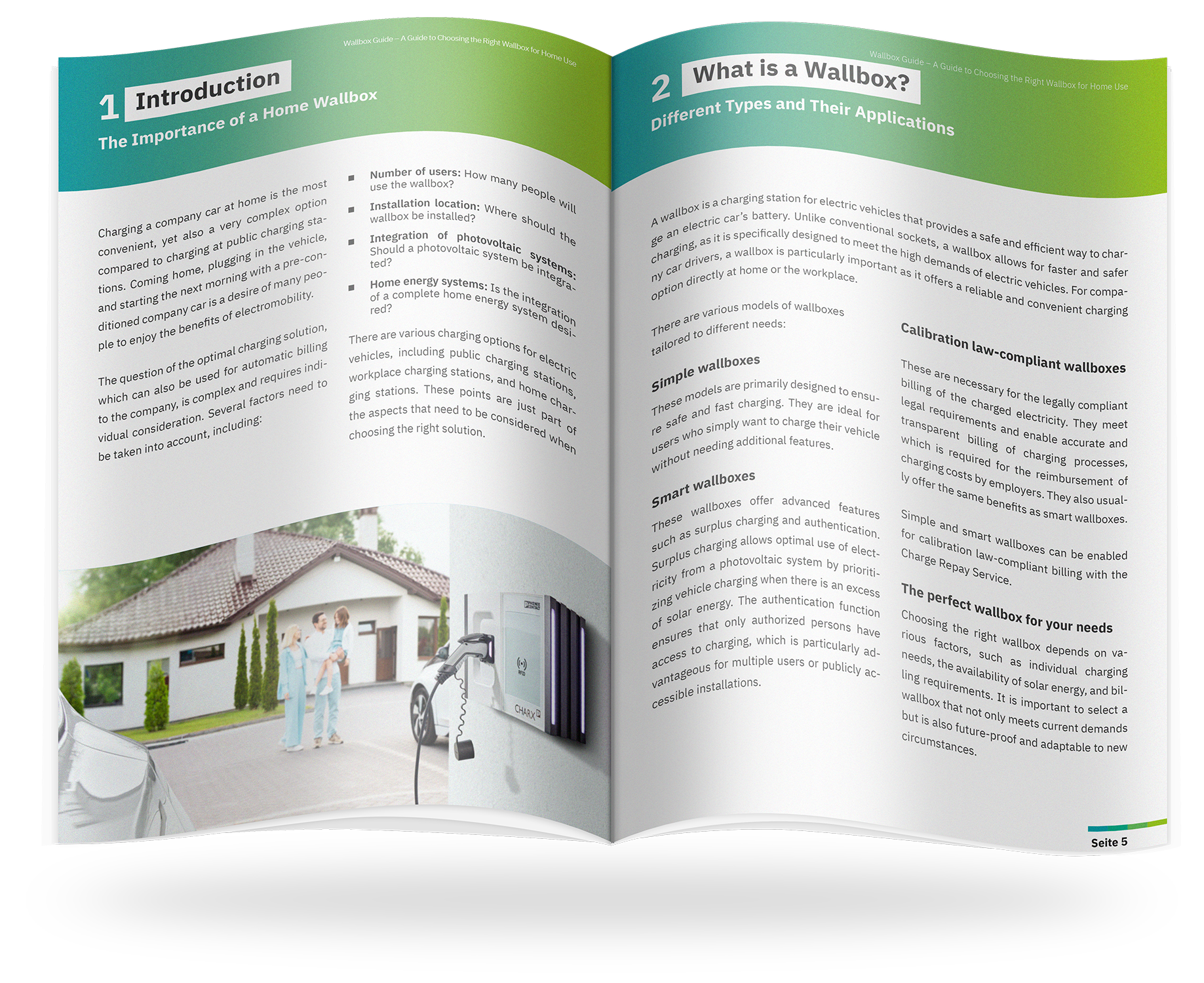
With home charging, the ID.7’s energy costs alone are €2,558 lower than the Passat’s. Without home charging, its electricity costs are €550 higher than the diesel costs. These figures exclude any additional allowance for charging losses. The tariff and energy amount are decisive, not the charging location alone.
For the company’s calculation, home charging is valued at the assumed reimbursement amount. This amount does not have to match the actual household electricity tariff. The assumed €0.32/kWh is used solely for calculation here and does not indicate eligibility for tax-free reimbursement. For more on reimbursement, see the article Electricity Rate Allowance 2027.
Other costs: Operation, charging infrastructure and administration
The following budgets cover the full four years and the new vehicle pair. They are our own model assumptions, not VW service quotations or binding insurance rates. Maintenance, repair contingency, tyres and insurance are budgeted afresh for these larger company cars. Charging infrastructure and administration remain process assumptions for the same company.
Maintenance, repairs and wear and tear: For the ID.7, we budget €2,400 for maintenance, €1,200 as a repair contingency and €2,400 for tyres and other wear and tear. For the Passat, we budget €3,600 for maintenance, €1,600 as a repair contingency and €2,000 for tyres and other wear and tear. A separate AdBlue budget of €300 is added for the diesel. The different tyre budgets are assumptions, not verified model-specific costs. Warranty or insurance reimbursements and maintenance items are not counted twice.
Insurance and other running costs: We assume an insurance budget of €5,600 for the ID.7 and €5,200 for the Passat, with comparable cover in principle. Both receive €1,200 for vehicle care and washing and €800 for statutory inspections, parking and small accessories. ADAC quotes annual vehicle tax of €263 for the selected Passat . This model figure is carried forward over four years, although the tax assessment remains authoritative. For the ID.7, assumed to be first registered at the end of 2026, we use zero euros of vehicle tax during the period considered. This is based on the vehicle-tax exemption for battery-electric vehicles described by German Customs . Sources accessed: 18 November 2026.
Charging infrastructure: Scenario A includes a one-off €2,000 for a home wallbox, installation and the required metering equipment. The model allocates this amount evenly over ten years of use, or €200 annually. The four-year vehicle period therefore accounts for €800. An unchanged €500 share of site infrastructure and €400 for operation and maintenance over four years are added. The infrastructure cost category in A therefore totals €1,700. Scenario B retains €500 for the site share and €200 for operation, totalling €700. The as-yet unallocated share of the home-charging investment is €1,200. It relates to continued use after the vehicle is replaced. We do not also deduct this share as resale proceeds. This assumes that the infrastructure can continue to be used accordingly. The allocation is a calculation assumption, not a statement about tax-mandated depreciation. Electricity is not included again here.
Billing and administration: All variants include €480 for general vehicle administration. Home charging adds a €480 service budget and €240 for internal checking, totalling €720. Without home charging, additional internal work for charging billing costs €240. For the Passat, fuel-receipt administration is included in the general administration budget. The service budget is provider-independent and is not a quotation for the Charge Repay Service.
Further assumptions set at zero euros: The baseline scenario includes no additional charging standing charges or blocking fees. Parking-space rent and productive working time lost while charging or refuelling are also set at zero euros. This assumes that charging and refuelling cause no additional paid downtime. Add these costs if they arise in the actual use case. Purchase grants, THG revenues and income-tax effects are not included; the comparison is before income taxes. The driver’s private company-car taxation is not part of this company TCO. Add any additional employer costs arising from a specific remuneration arrangement where applicable.

Total TCO: Which company car is cheaper in this example?
We now combine all the cost items described above. The table shows total costs over four years and 100,000 km. The energy item uses the charging scenarios calculated above; the other items follow the disclosed assumptions. Resale proceeds have already been deducted in the depreciation figure.
| Cost item | ID.7 A: with home charging | ID.7 B: without home charging | Passat TDI |
|---|---|---|---|
| Depreciation | €29,305.00 | €29,305.00 | €28,600.00 |
| Imputed capital costs | €6,504.40 | €6,504.40 | €6,128.00 |
| Delivery and registration | €800.00 | €800.00 | €800.00 |
| Electricity or diesel | €7,067.00 | €10,175.00 | €9,625.00 |
| Maintenance | €2,400.00 | €2,400.00 | €3,600.00 |
| Repair contingency | €1,200.00 | €1,200.00 | €1,600.00 |
| Tyres and other wear and tear | €2,400.00 | €2,400.00 | €2,000.00 |
| Insurance | €5,600.00 | €5,600.00 | €5,200.00 |
| Vehicle tax | €0.00 | €0.00 | €1,052.00 |
| AdBlue | €0.00 | €0.00 | €300.00 |
| Vehicle care and washing | €1,200.00 | €1,200.00 | €1,200.00 |
| Statutory inspections, parking and small accessories | €800.00 | €800.00 | €800.00 |
| Charging infrastructure including operation | €1,700.00 | €700.00 | €0.00 |
| General vehicle administration | €480.00 | €480.00 | €480.00 |
| Additional charging billing and service | €720.00 | €240.00 | €0.00 |
| Total TCO | €60,176.40 | €61,804.40 | €61,385.00 |
| Monthly average | €1,253.68 | €1,287.59 | €1,278.85 |
| Cost per kilometre | 60.18 cents | 61.80 cents | 61.39 cents |
| TCO difference compared with the Passat (+ more expensive; − cheaper) | −€1,208.60 | +€419.40 | – |
With the home-charging investment allocated over ten years, the ID.7 comes out ahead in Scenario A. The Passat TDI’s TCO is €61,385.00. The ID.7’s TCO is €60,176.40 with home charging and €61,804.40 without it. The ID.7 is therefore €1,208.60 cheaper in A, but remains €419.40 more expensive in B. The advantage in A requires continued use of the home-charging infrastructure after the vehicle is replaced. Residual values, cost budgets and a possible additional allowance for charging losses remain uncertainties.
The checking formula is: TCO difference = other ID.7 costs minus other Passat costs plus electricity costs minus diesel costs. In Scenario A, €1,349.40 in additional other costs is offset by an energy cost advantage of €2,558. This results in a calculated ID.7 advantage of €1,208.60. In Scenario B, the ID.7’s other costs are €130.60 lower, but electricity is €550 more expensive. The remaining additional cost is therefore still €419.40. Negative results indicate an advantage for the ID.7.
In the model, home charging reduces the ID.7’s total TCO by €1,628 compared with Scenario B. The electricity cost advantage of €3,108 is offset by €1,480 in additional infrastructure and billing costs. Only four of the home-charging investment’s ten years of use are allocated to this vehicle. The operating and billing costs for the four years are still included in full. This assumes that the company bears the allocated costs and that the infrastructure continues to be used afterwards.
Home charging also needs a suitable billing process
Companies that include home charging in their charging strategy need to organise recording and reimbursement. The cost of the billing process must therefore be included alongside the electricity price. The Charge Repay Service addresses this process, not the electricity tariff.
The Charge Repay Service automates the recording and billing of electricity used to charge company cars at home. The company receives a consolidated monthly invoice. Payments to company-car drivers can also be handled through the service.
Retrofit existing charging hardware instead of replacing it: If a hardware retrofit allows existing charging equipment to be reused for the required recording and billing, the cost of additional charging infrastructure can fall significantly. The size of this benefit depends on the existing hardware and the retrofit work required. Use the actual retrofit costs in your TCO instead of the cost of an entirely new installation. This potential cost benefit is not yet included in the infrastructure budgets in our example.
Compare the costs of both billing methods. For automated billing, add the service fees and the remaining internal effort. Compare this total with the cost of manual billing to see whether automation makes economic sense. Our TCO explicitly includes billing budgets for this purpose. They do not indicate the actual service price and do not assume any blanket saving in process costs.
Retrofitting with MID Meter, Legally Compliant Wallbox, or Charge Repay Service?
Discover your options for legally compliant billing of company car charging at home: When is retrofitting with an MID meter sufficient, when is a legally compliant wallbox required—and how does the Charge Repay Service bridge the gap without needing to replace your wallbox?
REQUEST WHITEPAPER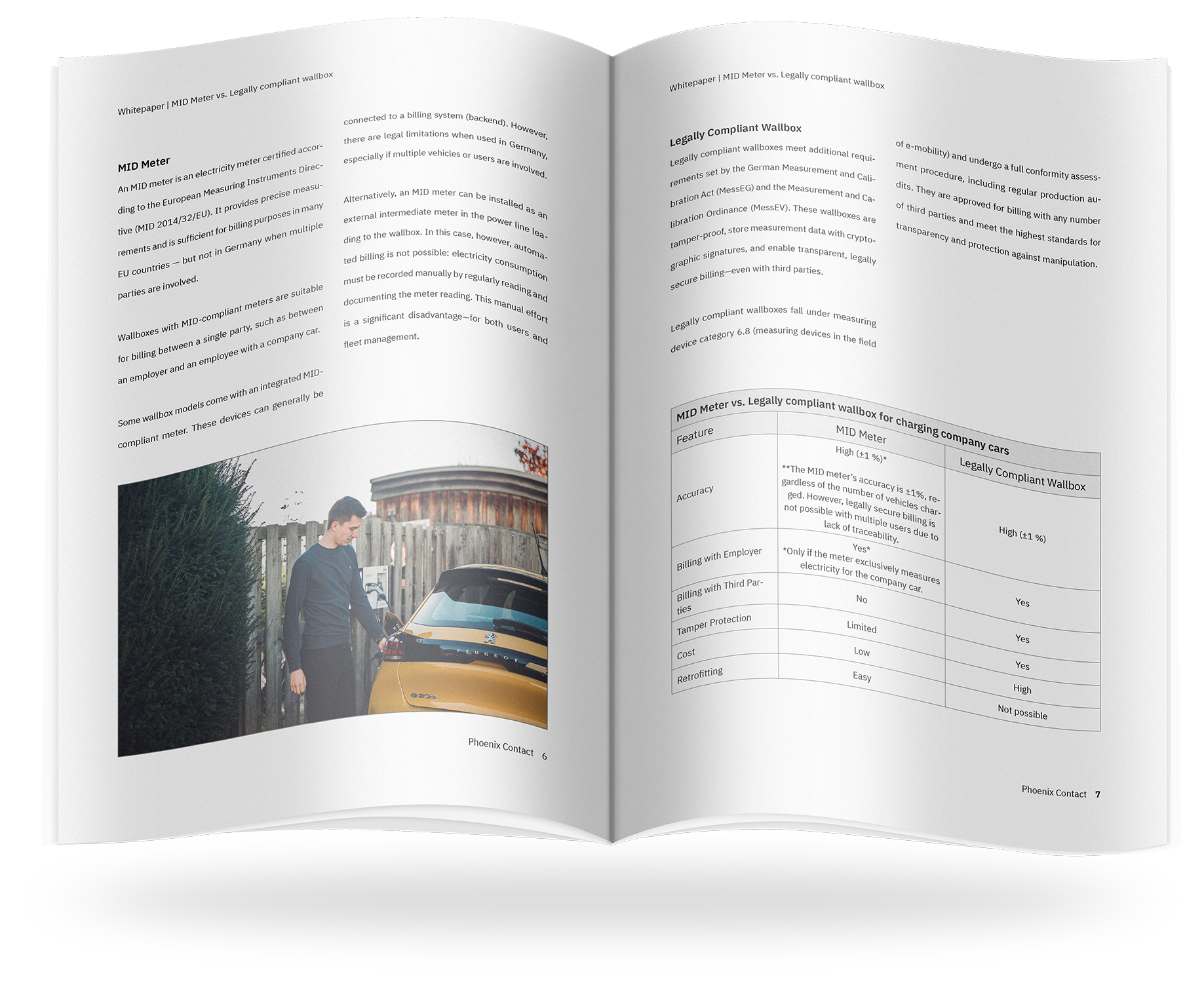
How to apply the comparison to your fleet
Our example provides a specific result, but it does not replace a calculation for your own fleet. These four steps adapt the calculation to the actual use case:
Define the use case: Determine the holding period, mileage and realistic consumption for both vehicles. For the electric company car, use the electricity drawn, including charging losses.
Determine the charging mix: Multiply the energy amounts at each charging location by the relevant price and add them together. Include additional charging fees. Weight the tariffs by the respective energy amounts.
Calculate an alternative: Check how costs change if home charging is unavailable or the public-charging share increases. Base this on the charging infrastructure actually available and the driving profile.
Recalculate total costs: Use actual purchase quotations that include the required comfort and driver-assistance functions. Support the resale proceeds after four years with suitable valuations or buyback offers. Include maintenance, repairs and tyres over the same period. The same applies to insurance, tax, AdBlue, infrastructure and administration. Check the tax basis and all items assumed to be zero.
As a cross-check, the energy amounts at all charging locations must add up to the calculated electricity drawn. In this example, both scenarios total 18,500 kWh, without an additional allowance for charging losses. Use the actual billed electricity consumption for your own calculation.
Conclusion: The ID.7 and Passat are close in this model
Over four years and 100,000 km, the ID.7 with home charging costs €1,208.60 less than the Passat TDI in the model. Without home charging, it is €419.40 more expensive. There is therefore no clear overall winner: the assumptions and use case are decisive.
The home-charging advantage assumes that the charging infrastructure remains usable for ten years. Additional charging losses are not included. Different purchase prices, residual values or running costs can reverse the result. Compare actual quotations and calculate using your real consumption and charging costs.