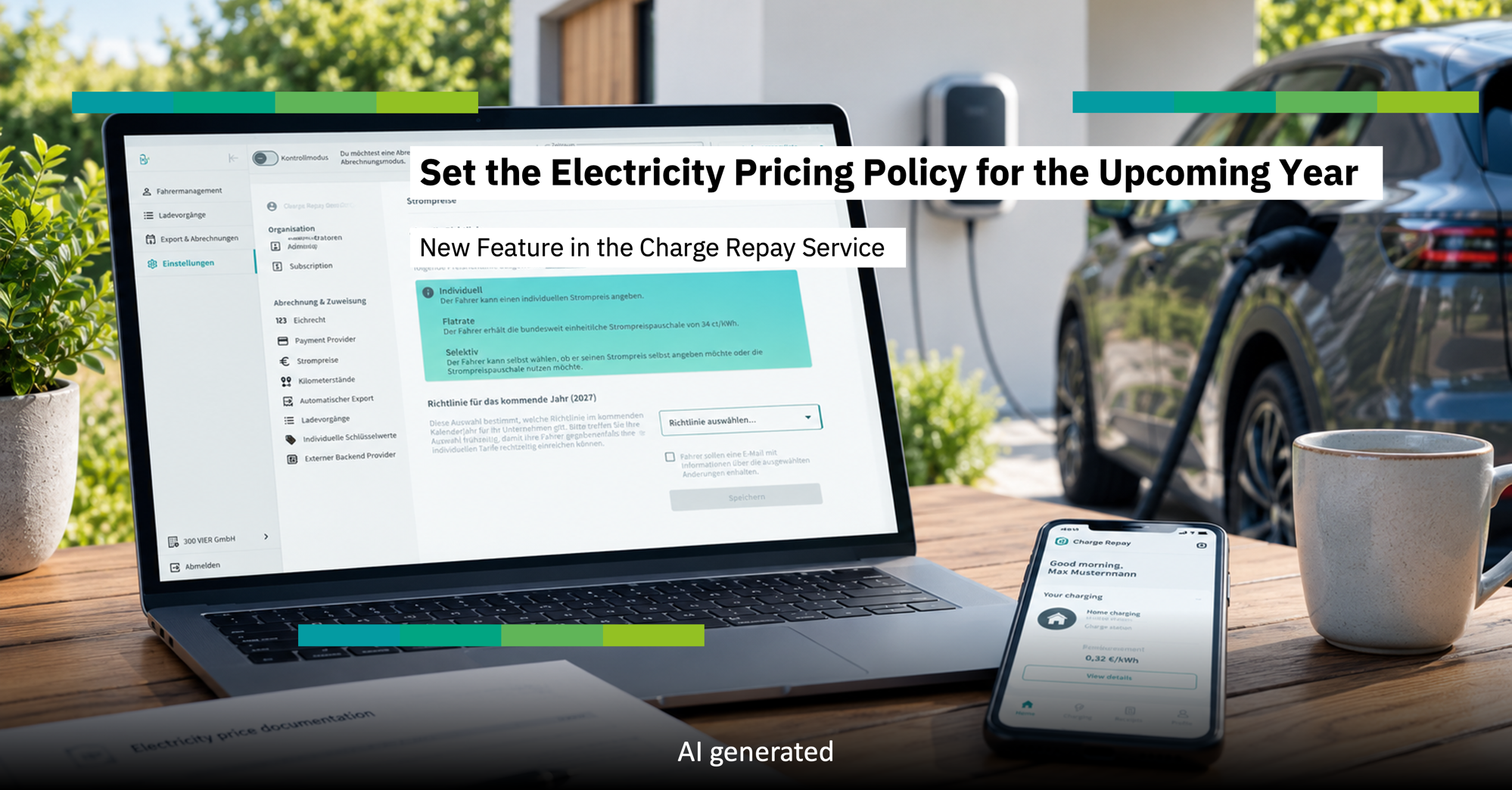
With the new electricity pricing policy, companies can centrally define how the costs of charging company electric vehicles at home are reimbursed. Three reimbursement options, verifiable electricity price documentation, and optional email notifications make it easier to implement company car policies with the Charge Repay Service.
Charging company electric vehicles at home has long been part of everyday business for many companies. However, with new tax regulations for electricity reimbursement coming into effect in 2026, fleet managers and HR departments face an important question: how should the electricity price used for reimbursement be determined — uniformly for all drivers or individually for each driver?
A new feature in the Charge Repay Service now enables fleet managers to make this decision centrally. They can define the electricity pricing policy that will apply to reimbursements for the upcoming calendar year. This allows company-wide reimbursement requirements to be implemented digitally and communicated transparently to drivers.
Three Options for the Electricity Pricing Policy
Companies have different requirements for their company car policies. While some want to minimize administrative effort, others want to account for their employees’ actual electricity costs as accurately as possible.
The Charge Repay Service therefore supports three electricity pricing options.
1. Standardized Electricity Rate: One Rate for All Drivers
Companies can define a standardized electricity rate per kilowatt-hour. Reimbursements are then calculated using the applicable flat rate for the relevant calendar year.
The benefit: drivers do not need to enter their individual electricity tariffs. Fleet management can reduce the effort required to collect and verify different electricity prices.
The standardized electricity rate is based on the guidelines issued by the German Federal Ministry of Finance and the average household electricity price for the first half of the preceding year. (Statistics code 61243-0001 from the German Federal Statistical Office ).
This option is particularly suitable for companies that prefer a consistent, straightforward arrangement within their company car policy.
2. Individual Electricity Price: Reflecting Actual Electricity Costs
Alternatively, companies can reimburse home charging based on each driver’s individual electricity price.
In this case, each driver enters their personal electricity price in cents per kilowatt-hour in the Charge Repay Service. They must also upload suitable documentation to substantiate the stated price.
Acceptable evidence may include electricity bills, contract documents, or other suitable documents from the energy supplier.
Fleet managers can access the uploaded documentation at any time and review it when necessary. This makes it possible to verify the basis on which reimbursements are calculated.
This option is particularly suitable for companies that want to account for individual electricity tariffs and align reimbursements as closely as possible with actual electricity costs.
3. Flexible Selection: Drivers Choose Between the Standardized Rate and Their Individual Electricity Price
Not every company wants to restrict its drivers to a single reimbursement method. The flexible electricity pricing policy therefore provides a third option.
Administrators can activate this option in the Charge Repay Service settings. Drivers can then decide for themselves whether to use the standardized electricity rate or enter their individual electricity price and provide the relevant documentation.
This creates flexibility without sacrificing centralized company-wide guidelines.
The three options at a glance:
Standardized electricity rate: One rate for all drivers, without individual electricity price documentation.
Individual electricity price: Each driver provides their own electricity price and supporting documentation.
Flexible selection: Drivers choose between the standardized rate and their individual electricity price.
One Electricity Pricing Policy for the Entire Calendar Year
An important new feature concerns not only the choice of reimbursement method but also the period for which it applies.
The tax regulations governing electricity cost reimbursement require a consistent choice of reimbursement method for the relevant calendar year. Switching between the standardized electricity rate and reimbursement based on individual electricity costs during the year is not предусмотрено.
The Charge Repay Service reflects this requirement through an annual setting: managers can define the electricity pricing policy for the upcoming calendar year. Individual drivers cannot change the active policy themselves.
This ensures that the selected reimbursement method is applied consistently throughout the company.
For fleet management, this means greater planning certainty. The company car policy can be established in good time before the new calendar year begins and configured in the service accordingly.
Download our charge@home Guide now!
Our guide highlights the requirements for a home charging solution and explains what is needed to use it for legally compliant billing of company cars. Learn more about the installation of wallboxes, legal frameworks, and efficient billing solutions for home charging.
REQUEST GUIDE
Inform Drivers and Request Individual Electricity Prices in Good Time
A new policy is only useful if the employees concerned understand what is expected of them.
The Charge Repay Service therefore offers an additional notification feature. When setting the electricity pricing policy, managers can optionally enable email notifications to inform drivers.
These notifications help communicate the new arrangements. For example, they can inform drivers that the requirements for the upcoming calendar year are changing or that the existing policy will remain unchanged.
This feature is particularly useful when a company intends to account for individual electricity prices in the future. Drivers can be asked in good time to enter their electricity price in cents per kilowatt-hour and upload the required documentation.
This leaves sufficient time to provide any missing information and ensure that everything is ready for smooth reimbursement in the new calendar year.
Greater Transparency for Company Car Policies
The new electricity pricing policy combines company-wide requirements with the practical needs of day-to-day reimbursement processing.
Fleet managers and administrators benefit from a centralized setting for the upcoming calendar year. At the same time, individual electricity prices and their supporting documentation are recorded transparently and can be accessed by authorized managers.
Optional email notifications also support communication between companies and drivers.
The Charge Repay Service continues to evolve in this direction: moving away from manual coordination and inconsistent requirements towards a transparent digital process for reimbursing home charging costs.
Would you like to simplify home charging reimbursement for your company EVs? Find out more about the Charge Repay Service and get advice on the options available for your company.