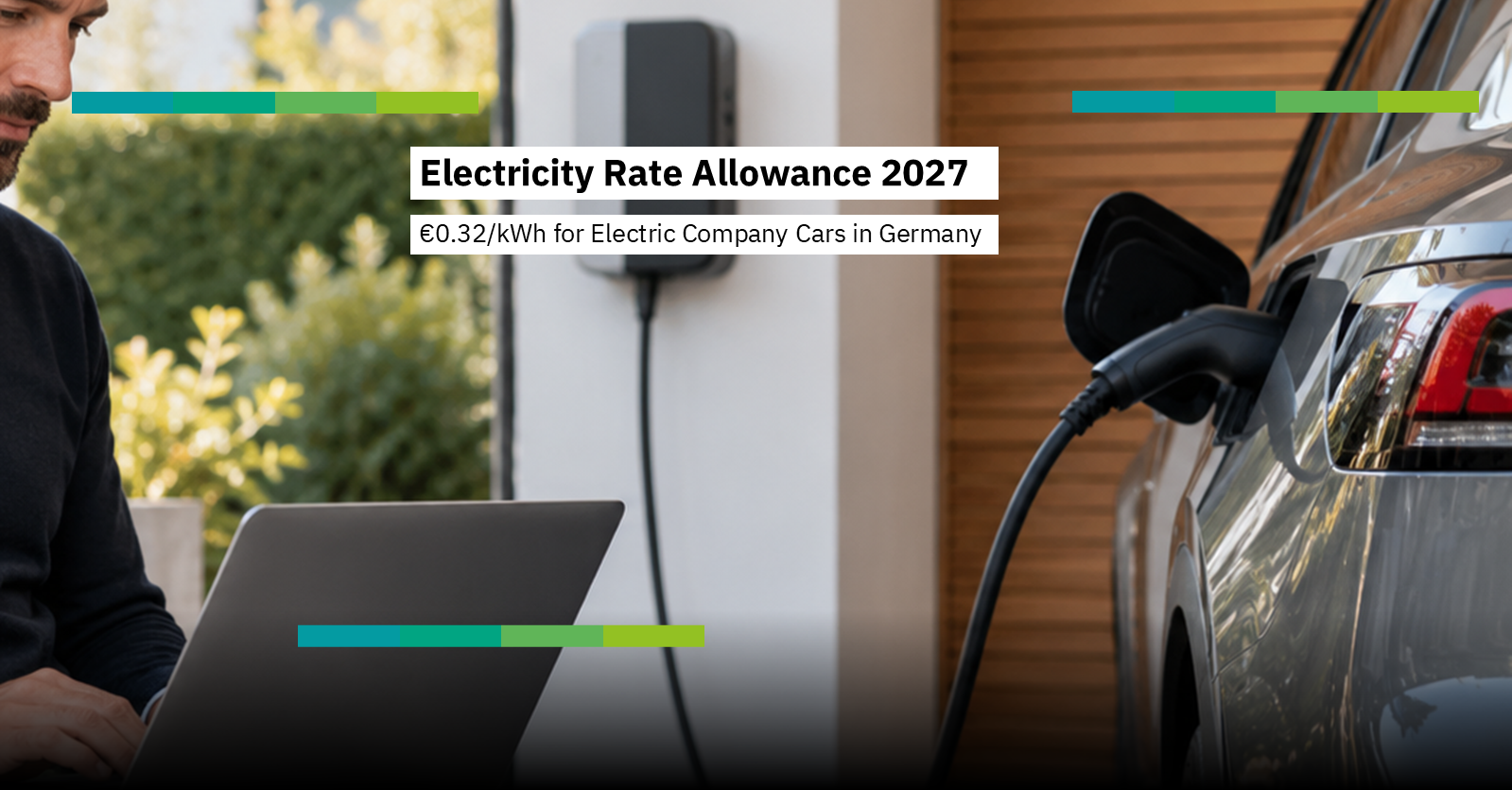
The electricity rate allowance for 2027 is €0.32 per kilowatt-hour (kWh). This means that companies can reimburse employees tax-free at a rate of €0.32 per documented kilowatt-hour charged at home for an electric company car, provided the applicable requirements are met. Compared to 2026, the allowance decreases by €0.02/kWh.
But what does this mean for company car drivers and fleet managers? And how can the new electricity rate allowance be incorporated into EV charging reimbursement processes?
What Is the Electricity Rate Allowance for 2027?
The electricity rate allowance is based on the average household electricity price for the first half of 2026, as published by the German Federal Statistical Office (Destatis).
| 2026 | 2027 | |
|---|---|---|
| Statistical electricity price | 34.36 ct/kWh | 32.14 ct/kWh |
| Applicable allowance | 34 ct/kWh | 32 ct/kWh |
Why Is 32.14 Cents Rounded Down to Exactly 32 Cents?
The German Federal Ministry of Finance (BMF) stipulates that the published average electricity price must be rounded down to full cents. As a result, the standardized rate for 2027 is €0.32/kWh. The data is based on Destatis table 61243-0001, consumption category 5,000 to under 15,000 kWh, including taxes, levies, and charges.
How Much Can Company Car Drivers Be Reimbursed in 2027?
The reimbursement amount depends on the documented amount of electricity charged at home for the electric company car. Calculation: Charged kWh × €0.32 = Potential reimbursement
| Charged electricity | 2027 reimbursement |
|---|---|
| 100 kWh | €32 |
| 250 kWh | €80 |
| 3,000 kWh | €960 |
Example: Anyone who charges 3,000 kWh at home for an electric company car during the year can receive up to €960 in tax-free reimbursement under the 2027 electricity rate allowance. In 2026, the reimbursement for the same charging volume was €1,020.
The actual reimbursement paid depends on the company’s reimbursement policy. The electricity rate allowance does not create an automatic entitlement to payment.
What Should Companies Consider Regarding the 2027 Electricity Rate Allowance?
The same principle applies in 2027: the electricity rate allowance only replaces proof of the employee’s individual electricity price.
It does not replace the requirement to document the amount of electricity charged. To qualify for tax-free reimbursement, the electricity charged at home must be measured using a suitable dedicated electricity meter. Alternatively, companies may reimburse employees based on their actual electricity costs.
The chosen reimbursement method must be applied consistently throughout the entire calendar year. The choice is made individually for each employee.
What Does the New Electricity Rate Allowance Mean for Fleet Managers?
For fleet managers, the 2027 electricity rate allowance is more than just a new calculation basis. It also affects reimbursement budgeting and annual charging reimbursement processes.
For example, a fleet of 100 electric company cars, each charging 3,000 kWh at home per year, would result in a calculated reimbursement volume of €96,000 in 2027 if the allowance is applied. This is €6,000 less than in 2026 with the same charging volume.
Companies should therefore review early which electricity pricing policy they want to apply for the coming calendar year and how it can be implemented efficiently.
Set the Electricity Pricing Policy for 2027 in Charge Repay Service
A new feature in the Charge Repay Service from Phoenix Contact allows fleet managers to define the electricity pricing policy for the upcoming calendar year centrally. Three options are available:
The standardized electricity rate allowance
Reimbursement based on individual electricity prices
Employee self-selection of the preferred reimbursement method
Optionally, employees can be informed about the new policy via email. This makes it possible to digitally manage different fleet requirements and organize EV charging reimbursements in a transparent manner.
Learn more about the new feature in our article “New Charge Repay Service Feature: Set the Electricity Pricing Policy for the Upcoming Year ”.
Conclusion: Prepare Early for the 2027 Electricity Rate Allowance
At €0.32 per kilowatt-hour, the electricity rate allowance for 2027 is now fixed. For companies and fleet managers, now is the right time to define the electricity pricing policy for the coming year and prepare charging reimbursement processes accordingly.
Whether you choose the standardized electricity rate allowance or reimbursement based on actual electricity costs, the key is a transparent and efficient reimbursement process for electricity charged at home.
Would you like to simplify EV charging reimbursement for your company cars? Learn how the Charge Repay Service can support your fleet management and discuss the options available for your organization. Schedule a non-binding consultation