When employees charge their electric company car at home or on the go, they initially incur the costs themselves. Companies are then faced with the question: How can these charging sessions be reimbursed or credited correctly—tax‑free, transparently, and without excessive administrative effort?
Why Is the Reimbursement of Charging Sessions Tax‑Free?
Reimbursement does not count as additional taxable salary in Germany but as tax‑free reimbursement of expenses, provided that the following conditions are met:
The charging session relates to an electric company car provided for business use
The actual amount of electricity charged is recorded in a traceable manner
The reimbursed amount corresponds to the actual costs incurred
In this case, the employer merely reimburses expenses—no taxable benefit in kind arises.
Important: As of 1 January 2026, flat‑rate reimbursements without measurement are no longer permitted in Germany. You can read more about this here: New rules for company car charging reimbursement from 2026.
Download our charge@home Guide now!
Our guide highlights the requirements for a home charging solution and explains what is needed to use it for legally compliant billing of company cars. Learn more about the installation of wallboxes, legal frameworks, and efficient billing solutions for home charging.
REQUEST GUIDE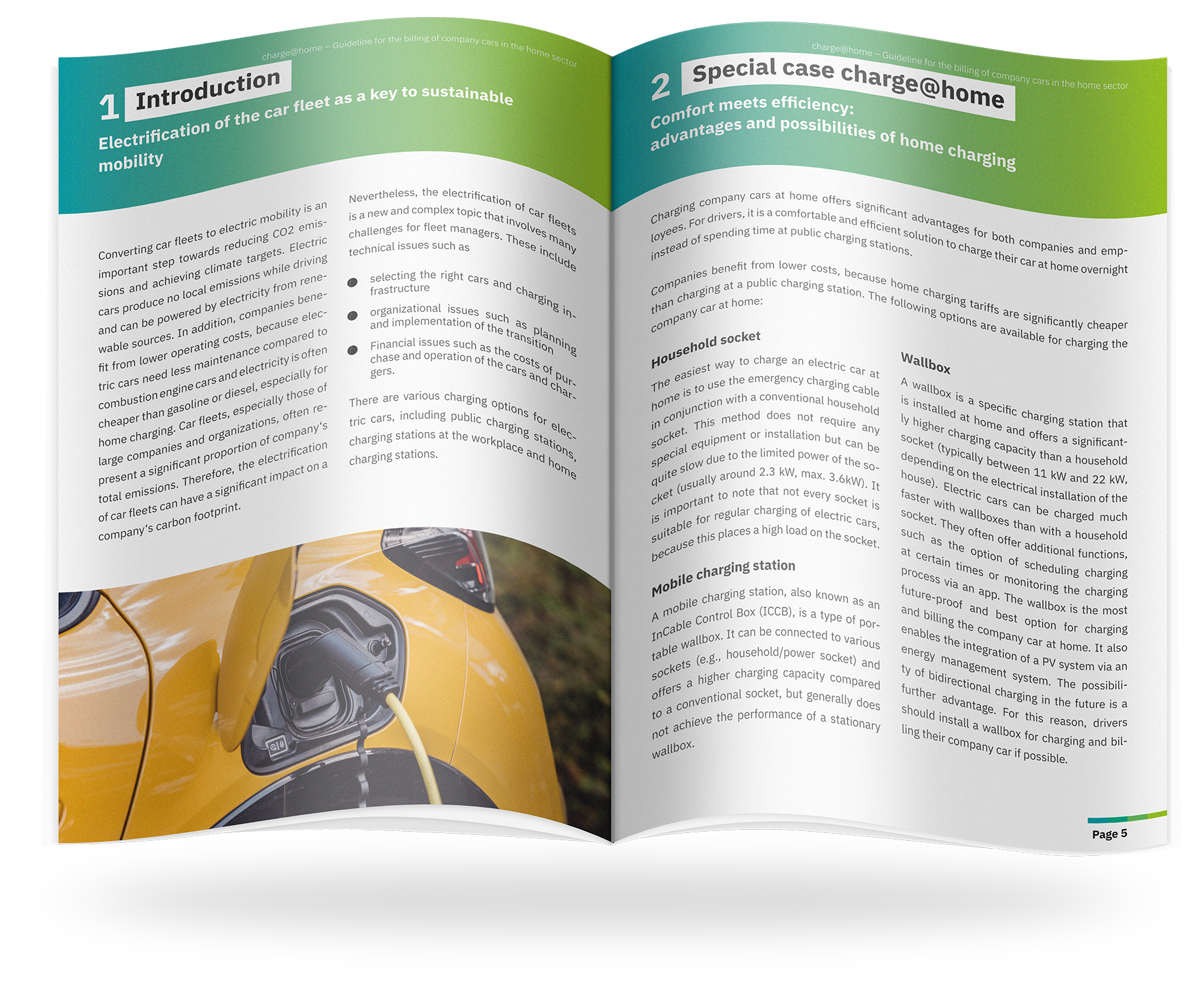
Which Legal Requirements Apply to Reimbursement from 2026 Onwards?
In a letter issued by the German Federal Ministry of Finance (BMF) in November 2025, the rules were clearly defined:
Elimination of Flat Rates
The monthly lump‑sum charging allowances valid until 2025 were abolished at the turn of the year. Since 2026, reimbursement is only permitted on the basis of measured charging sessions.
Mandatory Metering
The amount of electricity charged must be:
recorded precisely in kilowatt‑hours (kWh)
clearly assigned to a specific vehicle
documented in an audit‑proof manner
Permissible recording methods include:
stationary or mobile electricity meters
vehicle‑integrated charging data (e.g. via the vehicle app)
Important: German calibration and metering law (Mess‑ und Eichrecht) must be complied with. You can read more here: Calibration law vs. new BMF regulations.
Determination of Electricity Prices
Companies may choose between:
- the employee’s individual household electricity tariff (including a proportional base charge), or an official standardized electricity price per kWh
The chosen method must be applied consistently for the entire calendar year.
How Can the Reimbursement Process Be Designed?
In practice, three models have become established for reimbursing charging sessions. They differ primarily in their degree of automation and internal effort.
Manual Reimbursement
With manual reimbursement, employees report their charging sessions themselves—for example via charging reports, meter readings, or receipts. Verification and reimbursement are then handled by HR or fleet management.
Typical characteristics:
manual recording of charging sessions
review and payment by HR or accounting
high coordination effort
Assessment: This model is easy to implement but time‑consuming, error‑prone, and only limited in scalability.
Semi‑Automated Credit Process
In a semi‑automated solution, at least the measurement of the charged electricity is technically supported. However, the actual crediting or payment is still processed manually.
Typical characteristics:
automatic recording of kWh
manual processing in HR, payroll, or accounting
reduced measurement effort, but still many process steps
Assessment: This model increases transparency but only partially reduces the administrative workload.
Fully Automated Reimbursement
With fully automated reimbursement, charging sessions are processed digitally end‑to‑end. Recording, calculation, and payment are seamlessly automated.
Typical characteristics:
automatic recording of all charging sessions
compliant calculation of reimbursements
payment or credit without manual intervention
digital, audit‑proof documentation
Organisational and Legal Framework
In principle, reimbursement can be handled directly by the company itself. However, third parties may only manage the payout of reimbursement amounts if they are licensed as payment service providers with the appropriate banking or payment authorization.
This is particularly relevant in group structures where fleet management is organized centrally, but employees are employed by different, legally independent entities. In such cases, payment flows must be clearly defined and implemented in a legally compliant manner.
Assessment: This approach significantly reduces sources of error and administrative effort and is especially suitable for SMEs with a growing EV fleet, as well as for more complex organisational structures requiring a scalable and legally secure solution.
Retrofitting with MID Meter, Legally Compliant Wallbox, or Charge Repay Service?
Discover your options for legally compliant billing of company car charging at home: When is retrofitting with an MID meter sufficient, when is a legally compliant wallbox required—and how does the Charge Repay Service bridge the gap without needing to replace your wallbox?
REQUEST WHITEPAPER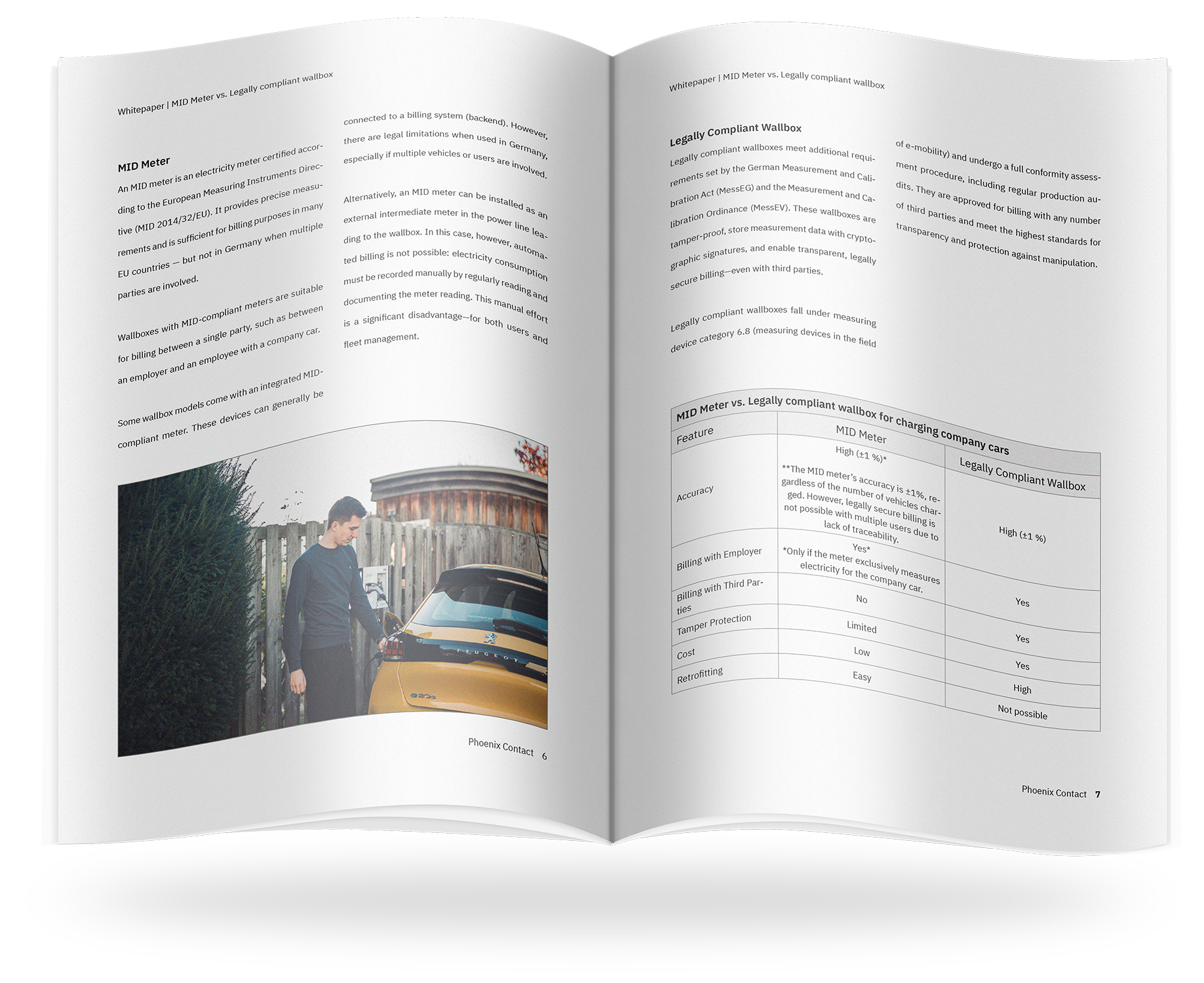
Reimbursement of Charging Sessions with the Charge Repay Service
The Charge Repay Service was specifically developed to fully automate the reimbursement of charging sessions—regardless of the wallbox used.
How the Process Works:
Recording of charging sessions The charged kWh are captured securely.
Automatic reimbursement calculation Electricity costs are calculated according to the applicable tariff.
Credit via payment service provider An integrated payment service provider handles the payout to employees.
Digital billing & documentation All reimbursements are transparently documented—verified and audit‑proof.
The Result:
No Excel spreadsheets
No receipt collection
No manual billing effort
Conclusion: Implementing Reimbursement Correctly Is Worthwhile
Reimbursing charging sessions is no longer a “nice‑to‑have”—from 2026 onwards, it is clearly regulated and must be implemented correctly.
Companies that:
rely on measured charging sessions
and digitalize the reimbursement process
save time, reduce risks, and increase acceptance among company car drivers.