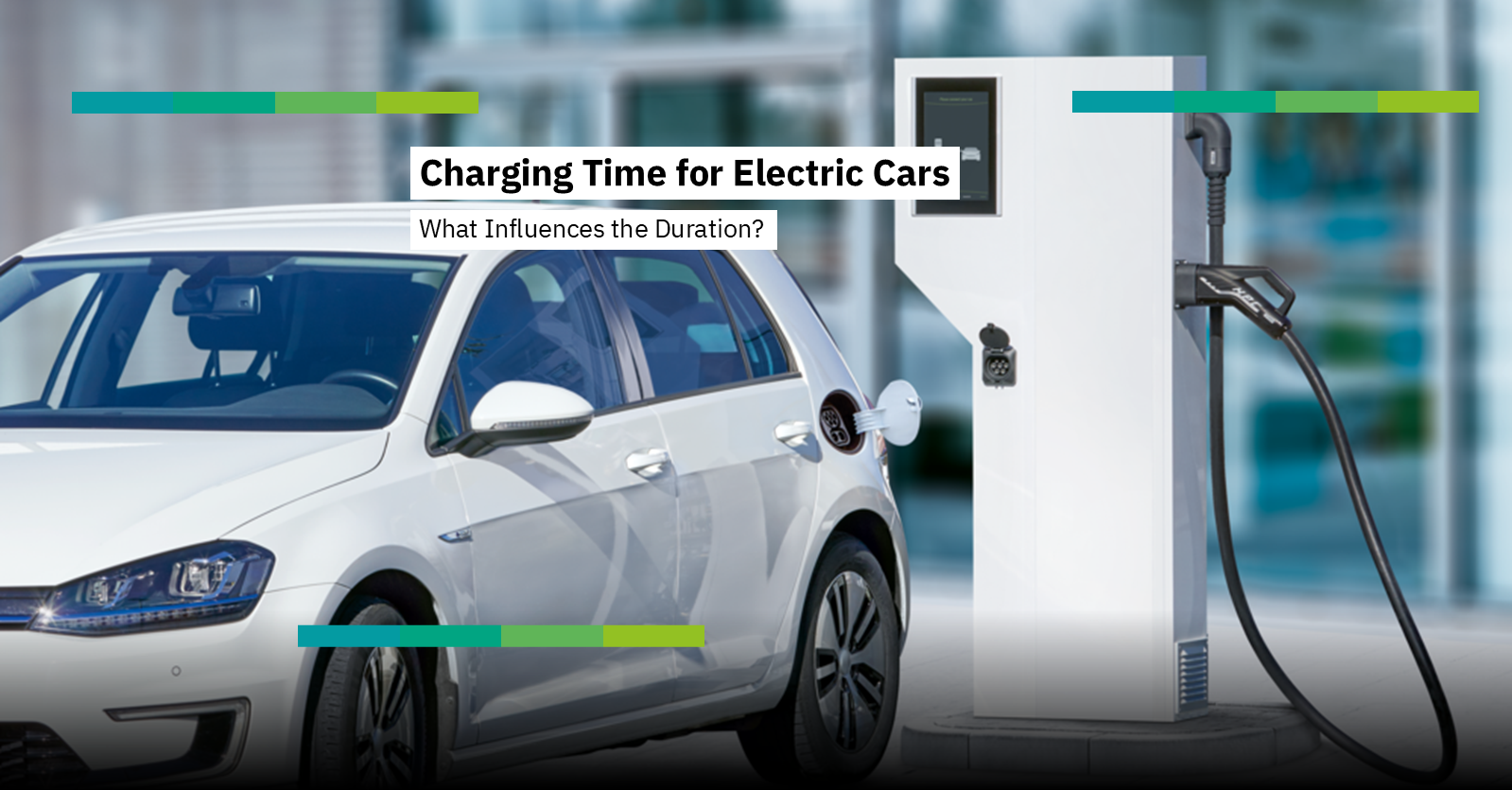
The charging time of an electric car is an important topic for many drivers. It determines how well the vehicle can be integrated into everyday life. There is no universal answer—the duration depends on several factors.
Overview of Charging Methods
Alternating Current (AC)
Charging with alternating current is the most common method, for example at home using a wallbox or while parking in the city. The charging time depends on the maximum charging power of the wallbox and the vehicle:
Schuko socket with 2.3 kW: 16 to 28 hours – only suitable as an emergency solution
Wallbox with 11 kW: About 4 to 8 hours – ideal for overnight charging
Wallbox with 22 kW: About 2 to 3 hours – if supported by the vehicle and the grid
Charging speed is also influenced by the vehicle’s technology. Some models charge single-phase, others three-phase.
Direct Current (DC)
Charging with direct current usually takes place at fast-charging stations along highways. The energy is transferred directly to the battery.
Charging from 10% to 80%: About 20 to 50 minutes – depending on charging power and battery capacity
Why only up to 80%? From this point onward, charging speed is reduced to protect the battery.
Additional Influencing Factors
Battery size: Larger batteries require more time
State of charge: The battery charges fastest between 10% and 80%
Outside temperature: Cold batteries charge more slowly – many vehicles offer preconditioning
Vehicle charging power: Depending on the model, up to 22 kW AC or 250 kW DC is possible
Calculating Charging Time
Alternating Current (AC):
Charging time ≈ Battery capacity (kWh) ÷ Charging power (kW) × 1.1 (losses)
Direct Current (DC):
Charging time ≈ Energy to be charged (kWh) ÷ (0.65 × maximum charging power) The factor 0.65 accounts for the typical charging curve over time.
Example:
A vehicle with a 60 kWh battery is charged from 10% to 80%. That equals about 42 kWh. With a DC charging power of 150 kW, the process takes around 24 minutes—longer at low temperatures.
Everyday Tips
Home charging: A wallbox with 11 kW is suitable for most households. Learn more in our blog post: Wallbox 11kW vs. 22kW
On the go: Charging planning with apps like EnBW mobility+ or Chargemap makes route selection easier
In winter: Charging times can increase by up to 30 minutes – preconditioning helps
Smart Charging: Intelligent control saves costs and relieves the power grid, but may extend charging time
Conclusion
The charging time of an electric car depends on many factors. With proper planning, charging can be easily integrated into daily life. Home charging offers comfort and predictable times. For fast charging on the go, it’s important to know your vehicle’s technology and the available infrastructure. Find more on the topic of e-mobility here .